
Find us
Follow us


After a year and a half of being split due to the redevelopment of their section of New Covent Garden Market, the fruit and vegetable wholesalers of the South London food hub reunite in the final section of its new Buyers’ Walk on January 12th. Having traded through upheaval, uncertainty and change, the moment represents not just the completion of the latest phase of a groundbreaking building project, but the start of a new chapter for the largest horticultural wholesale market in the UK.
Gary Marshall, Chairman of the Covent Garden Tenants’ Association and Owner of Bevington Salads, one of the wholesalers moving to new premises, talks about what this milestone really means: the loss of the old building, the promise of the new facilities, customer-driven changes to trading hours, the future of face-to-face wholesale trading – and the personal significance of a new clock that will bear his name.
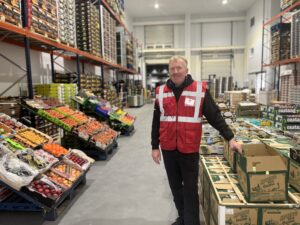
Gary in Bevington Salads new units on the all-new Buyers' Walk
It feels like the opening of the final section of Buyers’ Walk has been a long time coming. What does this moment mean for the wholesalers at New Covent Garden Market?
It’s hard to overstate just how significant this is. The “split” of Buyers’ Walk was originally meant to last 12 months, but in reality it stretched to more than 18 months. That period undoubtedly took its toll. We lost two wholesale companies during that time – Newmans, which closed around a year ago, and HG Walker, which stopped trading on Christmas Eve. That’s never what you want to see in any market, let alone one with our heritage.
For those of us who remained in the older building, it was challenging. We were working in a structure that was over 50 years old, functional but very much past its best, while seeing colleagues trading in brand-new facilities just across the way. Maintenance standards inevitably dropped, the building looked tired and grubby, and from a customer’s perspective it wasn’t ideal either. Buyers had to navigate a live building site and market traffic just to move between the two sections.
So the opening of the final section, and the fact we’re all together again in brand-new facilities, feels like a release. From January 12th, the new Buyers’ Walk will be fully occupied from day one. That’s incredibly encouraging. It feels like a new dawn for the market – and for many of us, a genuine fresh start.
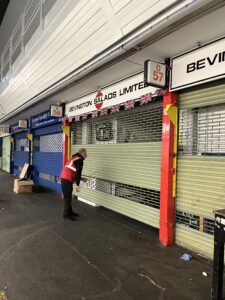
Gary draws down the shutters at the end of the final night in the original NCGM Buyers' Walk
As ever when change occurs, there are no doubt mixed emotions surrounding the closure of the original Buyers’ Walk building. How do traders feel about leaving it behind?
There’s no denying we’ll all have a sense of sadness. Many of us traded in that block for four decades or more. Over the years, we upgraded our units and did what we could, but we all knew the building was old and tired.
Those walls hold an enormous amount of history. There are memories of incredible trading days, unforgettable characters, and people who were not just colleagues but family and friends. Sadly, many of those who worked in that building are no longer with us. Some of them were the forefathers of this industry – exceptional traders and buyers whose influence is still felt today. When we move across, they’ll certainly be in our thoughts.
In 1974, when the market relocated from WC2 to Vauxhall, there was real apprehension. It was only two miles away, but it felt like a different world. Those buildings carried us through the next 50 years and gave us countless memories. While we’re leaving the bricks and mortar behind, we’re not leaving the site, the location, or the heritage. New Covent Garden remains perfectly positioned for customers across London and the South East.
What excites you most about the new facilities and what they can unlock for traders and customers alike?
The transformation is extraordinary. We now have a secure, well-lit, temperature-controlled and fully enclosed Buyers’ Walk. That alone changes everything.
Each unit is state-of-the-art and fully monitored. Instead of moving premium product between ambient and cold environments, everything will be kept in controlled conditions from arrival to sale. That’s better for quality, shelf life and confidence – not just for wholesalers, but for growers and suppliers too. It encourages them to send us the very best produce, knowing it will be handled correctly.
These facilities will also allow us to expand ranges and increase volumes in a way we simply couldn’t before. Better storage and display naturally lead to better presentation, which attracts new customers and helps existing ones grow their businesses. It’s a virtuous circle.
We’re also seeing a really exciting blend of people on Buyers’ Walk now. Alongside familiar faces, there’s a growing number of younger, highly motivated traders. Despite our unsociable hours, we’ve managed to attract incredibly talented and entrepreneurial young men and women who I genuinely believe will lead the market successfully into its next chapter.
You’ve spoken before about this being a moment of renewal, even personally. Can you expand on that?
I’m 64 years old. Most people at this stage might be thinking about winding down, but instead I feel like I’m putting a new pair of boots on and going again. And I’m not alone - there are plenty of traders here who feel exactly the same way.
On a personal level, it’s particularly meaningful. My son George is now running our business, and my eldest son Bradley is returning from New Zealand at the end of January to be part of this next phase. We’ve also taken on a new trainee (!) - Bobby Kent, who’s 69 years old and brings a lifetime of experience. Between our team alone, we’ve probably got 300 years of combined market knowledge.
Without the investment in these new facilities, I’m not sure we’d have been able to retain all our staff, let alone recruit new ones. That’s why this matters so much – it secures jobs, encourages new talent and keeps the market alive.
Buyers’ Walk has always been seen as the heart of the market. Why was it so important to preserve and invest in it?
Giving up that amount of space to Buyers’ Walk demonstrates how strongly we believe as a market in its intrinsic value. In a world increasingly dominated by emails, WhatsApp and remote working, face-to-face trading is becoming rare – but it’s also more important than ever.
There is nothing like the experience of standing in front of a pallet of newly delivered fresh produce, talking directly to the buyer, negotiating, shaking hands and closing a deal. You can’t replicate that over a phone or a message. I’ve traded all my life, and that buzz has never faded.
I’ve visited markets all over the world, most recently in Melbourne, and the best examples all cherish their Buyers’ Walks. They offer buyers the chance to see, smell and taste products, and to build trust in the expertise of the people selling them. That experience is priceless.
When first-time visitors come here – whether from government, trade bodies, or overseas – they’re often blown away by the energy, the knowledge and the sheer variety and quality of produce on display. That adrenaline rush is something we should never take for granted and it needs preserving for the salesmen and women coming through the ranks.
One of the biggest changes being discussed is the extension of opening hours. What’s the thinking behind that?
The split Buyers’ Walk disrupted not just trading, but also our working patterns. While we’ve always prioritised our in-house foodservice customers – and rightly so – I think, unintentionally, we’ve made it harder for some external customers to trade with us.
Think about an independent greengrocer or street trader. Asking them to be here at 2am, work all day, and then repeat the process isn’t sustainable. What we’re proposing is simple but potentially transformative: from January 12th, Buyers’ Walk will stay open until 7am on trading days for an initial six-month trial, with the full show still out. This gives customers the chance to visit later in the morning, when deliveries have gone out and Buyers’ Walk is still fully operational and ready to deal with their specific needs.
What’s been incredible is the response [to this] from traders. You’d expect resistance when you tell people their working day may increase by two or three hours, but the reaction has been overwhelmingly positive. That says everything about the spirit of New Covent Garden. When times are tough and opportunities present themselves, people always roll their sleeves up.
Finally, there is a new clock being unveiled by your fellow traders in your honour. How does that feel?
Humbling – genuinely humbling. I’ve been Chairman of the Tenants’ Association for over 20 years, and in that time I’ve seen wonderful highs and some very challenging moments. But the support of this community has never wavered – not just for me, but for the charities we support.
Over the years, we’ve raised close to a million pounds for causes including Anthony Nolan, Trinity Hospice, Help for Heroes and many others. That’s something the entire market should be proud of.
To then receive a lifetime achievement award for the industry, and to be told there will be a clock named in my honour on the new Buyers’ Walk – it’s overwhelming. There are moments when you ask yourself if all the meetings, the battles, the sacrifices are worth it. That clock answers that question for me. It says yes – absolutely yes.
This market is part of who I am. And as we open this new Buyers’ Walk, I truly believe this is New Covent Garden’s time to shine.