Find us
Follow us

Six months into his tenure as General Manager of the Covent Garden Market Authority (CGMA), Rob McAuliffe talked to food broadcaster and Market supplier Chris Bavin to reflect on his first impressions, the progress of redevelopment at New Covent Garden Market, and his vision for the site’s future
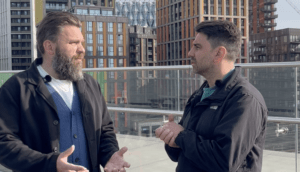
Chris Bavin (CB): Rob, six months in, how have you found the role?
Rob McAuliffe (RM): It’s been incredibly rewarding, but equally demanding. NCGM has its own unique ecosystem – it’s not just a market, it’s a community and a vital supply hub in London’s food and flower supply chain. Over the past six months, I’ve spent a lot of time listening to tenants, staff, customers and to the wider stakeholder base. That’s been essential in understanding both the day-to-day realities of trading and operating here and the bigger strategic challenges ahead of us.
I’ve been struck throughout that time by the resilience and professionalism of the businesses here. Despite ongoing pressures – cost inflation, the global climate, staffing challenges and the lasting impact of Brexit – this Market continues to operate efficiently and with real energy. That gives me, in my role, a strong foundation on which to build.
CB: It must have been a completely different world for you coming in?
RM: It is - and I think it would be for most people. The reality is that not a lot of people even know this place exists. They might have some indirect connection to it through the food or flower business, but very few people understand the nuances or the scale of it.
This is the leading wholesale market in the UK and one of the biggest in Europe, yet it largely operates out of public view. Coming in, I knew about the site through railway arches - my previous role involved managing those kinds of estates, but I had no idea how vast or complex the Market itself was until I arrived.
Wholesale markets are fundamental to how cities function. What you’ll find here is expertise, dedication and a level of service that is extremely hard to replicate. Our job at CGMA is to support that and ensure that NCGM remains a place where London’s food and flower suppliers can operate successfully and sustainably.
CB: You came from a property and development background. Has that helped?
RM: Definitely. I worked for The Arch Company, which manages railway arches across England and Wales, so I understood the estate side of things. Interestingly, some of the arches here connect back to that world – although historically the Market was acquired through a compulsory purchase order when it moved from central London in the 1970s.
So, I had some familiarity with the physical infrastructure, but not with the wholesale industry itself, and that’s been the real learning curve.
CB: You’ve arrived at a pivotal time — right in the middle of redevelopment. Where are we now?
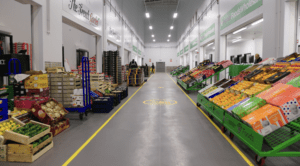
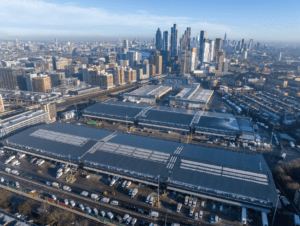
RM: We’re at a really important stage. Two new blocks are complete and operational, and Buyers' Walk, which is the central spine of the Market, opened earlier this year. That was a significant milestone. The next phase is Block C. We’ve got less than a quarter of the old Market buildings left. The plan is to move tenants into the next new block, demolish and clear the remaining section, and complete the final build-out of the fruit and veg market. Within the next 12 to 18 months, that part of the redevelopment will be finished.
After that, attention shifts to the Flower Market, which will move into a purpose-built facility directly beneath where we’re standing now [the roof of the Food Exchange] and across the front of the site.
From its origins in the original Covent Garden in the West End, it relocated here, then into a temporary structure near the US Embassy. That “temporary” building has been in place for about a decade. What we’re doing now is giving the Flower Market a permanent, high-quality home and, more than that, positioning it as a real focal point. With its glass frontage and prominent location, it has the potential to become the “shop window” of the entire site.
CB: And everything will finally be in one place?
RM: Exactly. That’s hugely important. The site has reduced in size - from around 53 acres to about 39, but when the Flower Market is completed, everything becomes far more joined up It’s still a large footprint, bigger than the Battersea Power Station development, for example, but it will function as a connected, walkable destination.
The redevelopment has delivered modern, high-quality facilities that have transformed the trading environment. Many tenants now operate out of purpose-built units that are better suited to the needs of a modern wholesale business – improved logistics, better temperature control and more efficient layouts.
We’re not there yet though. There are still several elements of this project to be completed and there is a continued focus on ensuring that the site is a coherent whole. A key part of our work is to continue to ensure that the redevelopment does not impact on the ability of tenants to trade effectively on a day-to-day basis.
CB: You’ve spoken before about the importance of the Market to London’s food system. How do you build on that?
RM: One of the most striking things for me has been understanding the Market’s role in food security. During COVID, when supermarket supply chains struggled, this Market continued to operate effectively because of the way wholesalers source and distribute produce.
That’s incredibly important, but it’s not widely recognised. I believe part of our job is to strengthen that story and make sure it is heard by a wider audience.
At the same time, we need to broaden the offer. At the moment, we supply some of the best restaurants, caterers, schools and institutions in London. Crucially, the site benefits from strong public access via the Nine Elms and Battersea Power Station Tube stations, the US Embassy, and major footfall routes. That gives us a real opportunity to open up the Market in a way it hasn’t been accessible before - there’s an opportunity to bring the public in and make this a visible part of London’s food culture.
CB: So are we talking about a mix of retail, hospitality and wholesale?
RM: In essence, yes. The difference when you look at other food markets is that wholesale will remain the foundation here. What we want to do is build on that, not replace it.
There’s a natural synergy between wholesale, retail and foodservice. If you connect them properly, they can reinforce each other. You’ve got produce coming in from across the UK and Europe, being traded by experts, and then the potential to showcase that directly to the public - through retail, dining and events.
We want it to become a destination, something more akin to the great European food markets, where the public understands and values what’s happening behind the scenes.
CB: Like Rungis in Paris, for example?
RM: Exactly. In Paris, people know Rungis. They’re proud and protective of it and there’s an understanding of its importance and a connection to it. That’s what we want to build here — a sense of pride and engagement. Whether someone is a large-scale buyer, a local resident, or just visiting for a meal or to buy produce, they should feel connected to the Market.
What excites me is the chance I have to help shape this market’s future. Working along others to evolve NCGM in a way that meets the needs of London, while staying true to its core traditional strengths.
CB: There’s also an educational element to that, isn’t there?
RM: Absolutely. One of the most valuable things we can do is reconnect people with where their food comes from. Wholesale markets are uniquely placed to do that because they sit at the intersection between producers and consumers.
On top of that, we have initiatives like Mission Kitchen on site – an incubator that supports food start-ups. It’s helping people turn small ideas into scalable businesses. That’s another dimension of what this place can be: not just distributing food, but creating food businesses.
CB: So, the ambition is to become a full food hub?
RM: That’s exactly it, a genuine food and flower hub. A place that supports wholesalers, fosters new food businesses, connects producers to consumers, and offers something to the public.
If we get it right, it will be a one-stop ecosystem for food and flowers in London.
CB: What does the timeline look like?
RM: The core redevelopment should complete around the fourth quarter of 2028. We’re aiming to have the new Flower Market operational before then, ideally with enough time for traders to embed themselves ahead of the key Christmas trading period.
From around 2028 to 2030, we’ll be focused on building out the wider offer, particularly the public-facing elements. That means developing food and beverage operations, retail experiences, and events in a way that works alongside the wholesale businesses.
CB: Are you already seeing signs of that shift?
RM: Yes, early signs. Some traders are beginning to experiment with opening to the public - for example, on Saturdays when Mercato Battersea opens up on Buyers’ Walk.
Buyers’ Walk itself has the potential to become a major public space. It’s essentially a huge, 300-foot corridor; one of the largest covered open spaces in London. We’re introducing new cafes, which serve traders overnight and could also cater to visitors during the day. These are small steps, but they’re the seeds of what the market could become as it adds to its fantastic wholesale heritage.
CB: There are practical challenges though - different operating hours, staffing, logistics…
RM: Of course. Wholesale operates overnight, so asking businesses to extend into daytime retail isn’t straightforward. It requires different staffing models, different skills, and a different mindset.
It’s not something we can impose. It has to evolve organically, in partnership with or driven by tenants. And from the Authority’s perspective, we also need to ensure the infrastructure is there: security, health and safety, and the right supporting services.
But if it works commercially, I strongly believe it will gain traction.
CB: Finally, what excites you most about the future?
RM: The opportunity to unlock what’s already here. This is already a hugely important £1bn Market, with incredible businesses and a critical role in the supply of food and flowers to London, the South East and further afield. Combined, NCGM’s tenants are a major employer base, a vital pillar in London’s fresh economy. They are an unmatchable connection for growers from Britain and overseas to a huge network of catering, hospitality and corporate customers they would find it extremely hard to access otherwise.
What we’re trying to do is amplify that - to make it more visible, more accessible, and more connected to the city around it. If we can successfully combine wholesale excellence with a strong public-facing offer, we can create something truly special.