Find us
Follow us

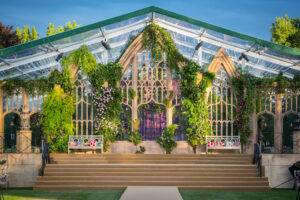
In a studio tucked down a side street not far from Battersea Park, London event florist Woodbrown specialises in creating immersive worlds for a broad range of clients. Much more than just floral arrangements, the environments it creates always show a deep respect for the beauty of flowers and plants. And the secret behind this design powerhouse? The men and women at New Covent Garden Flower Market, who supply everything needed for the projects
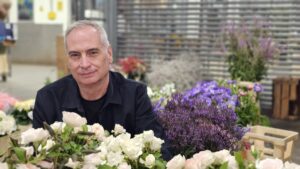
At the centre of Woodbrown are co-owners Christopher Hammond-Davis (pictured below in the Flower Market) and Marie Sweeney, known by all as Maisie, who have been shaping some of London’s most memorable events for the past 30 years. From huge events such as the British Academy Film Awards (better known as the BAFTAs – more on that later), to deeply personal weddings, the company’s work is defined not by scale, but by care and attention to detail.
“We absolutely love creating something unique and individual for each event,” says Christopher. “Whether it’s an intimate dinner or a stunning wedding, each one is treated the same where we’ll look at style, integrity and design.”
It’s a philosophy rooted as much in storytelling as in floristry, perhaps unsurprising given Christopher’s origins. “I started off as an actor attending the then 'Italia Conti Stage School' based in Clapham, he explains. “I worked in film and television from the age of 11 and then on to stage at the age of 16. Like many performers, I had to navigate the unpredictability of the industry. It’s feast or famine when you’re an actor and at 26 I’d just got a mortgage, so I needed a backup income.”
A chance encounter changed everything. Asked if he wanted to help dig over a garden one morning was a shock to the system. “An eight o’clock start!? You’re still going to bed at eight o’clock in the morning when you’re an actor,” he laughs. That gig took Christopher to a Kensington florist and what began as a driving job quickly turned into something more immersive. “It was in at the deep end, really,” he recalls. “They’d say, ‘Try and copy this arrangement.’ I was doing contracts, installations, going to the Flower Market. I was absorbed by the mechanics of floristry and its creative possibilities.” During this time, Christopher was still working occasionally in television and theatre and published two books on floral decoration. He later freelanced at Kenneth Turner Limited, where he worked closely with Simon Brown, the “Brown” behind Woodbrown.
When Simon and his wife Cynthia Wood founded the business, Christopher was there from the start. Five wonderful years later Simon sadly died of a heart attack aged just 44. “He was like a brother to me, says Christopher.” In the wake of that loss, Cynthia asked if Christopher would run the company. Together with Marie, Christopher stepped into the role of running the business. “I first met Marie on the Avenue Princesse Grace Monte Carlo, as part of Simon's team of florists,” reminisces Christopher. “We’re still in the same studio Simon was in, and we feel like he’s always there.”
That sense of continuity is central to Woodbrown’s identity. “I try and keep to his ethos,” Christopher explains. “Sometimes I think, Simon would say ‘what are you doing now, Christopher?’ and that’s where memory and instinct overlap. Every now and then, I dream he comes back,” he adds. “Usually when something difficult is coming up, it’s like he’s there to help.”
Events are rarely just flowers and plants and projects often evolve into immersive environments, shaped by narrative as much as design. A Cuban-themed wedding at Battersea Arts Centre (working with the party planner Philip Pleydell-Pearce) is an example. “We wanted it to feel like a street party,” Christopher explains, “so we created little bistros and buildings, so that you were walking into a different world.”
The concept was developed collaboratively with a longstanding client. “We knew the family already, so when they said, ‘we want this Cuban theme,’ we could run with it.”
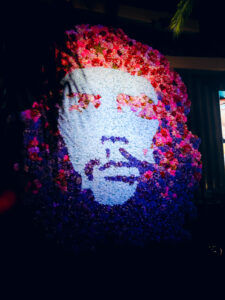
The result was extraordinary: a fully realised streetscape complete with graffiti-style installations, sculptural elements and a towering centrepiece. “We created a 15-foot Che Guevara,” Christopher says (pictured above). “Che’s profile was created entirely from faux hydrangea so it could be kept as an art installation after the event. Everything was sourced from the Flower Market and the project took months to refine. We worked on it for quite a while, maybe 12 weeks,” he says.
“But sometimes you get offered something that big and you’re only given a month’s notice. That’s just how it is.” Despite the spectacle, the emphasis is on personalisation. “We find the client’s individual style and work with them to develop a design reflecting their taste,” Christopher explains. “It’s about meeting their requirements and their budget.”
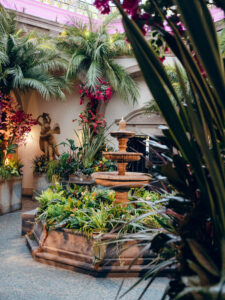
As conversations around sustainability intensify, Woodbrown has been quietly adapting its practices. “We are as sustainable as possible,” Christopher says. “We try not to use floral foam unless there’s no other way.” Instead, the team relies on water-based designs, reusable structures and traditional techniques. “Chicken wire gets used multiple times.” The Cuban wedding offered a blueprint for a more circular approach, something that they’ve increasingly adapted to other projects. “The majority of what we used wasn’t cut flowers, it was plants,” says Christopher, adding that everything got to live on via donations after the event.
Installations were repurposed or donated, with plants finding new homes in gardens and via local charity Thrive Battersea. “For the client, it was very important that everything had a second life,” explains Christopher. “They said, ‘What do we get to keep?’ and the answer was quite a lot. You’ve got to look at it in totality,” he says. “Flowers bring a lot of pleasure. And we were able to use those flowers and plants to bring pleasure to people during and after the wedding.”
Although it has created a worldwide reputation and reach, Woodbrown remains deeply connected to its local roots as a huge advocate of everything NCGM has to offer.
“We’ve always supported the Market,” Christopher says. “We don’t order flowers online, we visit several times each week for inspiration.” It’s the physical interaction, he insists, that is irreplaceable. “You can pick up two bunches, put them together, see how they work. Smell them, understand the colour, the longevity.” The Market is also a hub of shared knowledge. “It’s a virtuous circle,” he says. “You tell suppliers what’s worked, what hasn’t. They guide you.
You can’t replicate that.” Equally important is the sense of community. “You’re buying with your competitors all around you,” he says. “You’ll have breakfast with them and chat about upcoming projects.” You might suspect there would be rivalry, but Christopher says that isn’t the case, as there’s enough work to go around. “People do different things and you’re all in different lanes,” he says.
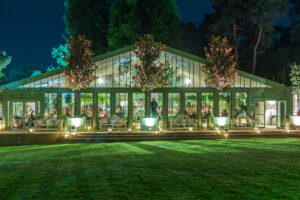
In an era dominated by social media, Woodbrown operates differently. “We don’t get much business from Instagram,” Christopher admits. “It’s mostly word of mouth, and that’s partly by necessity,” he says, adding that high-profile clients often require complete discretion. “So much of the work we do is under non-disclosure agreements (NDAs), so we can’t shout about it as much as we’d like to” he says. Even standout projects that appear in publications rarely translate directly into business. “We’ve had events featured in Tatler and House & Garden but, surprisingly, you get very little business from it,” he says.
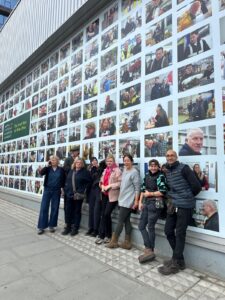
Instead, Christopher and Marie have built their business on long-term relationships. “We’ve been working with some party planners for more than 30 years,” he says, “and it’s the same with some production companies.” Relationships are essential when timelines frequently tighten. “Sometimes you’ll get a massive event with a month’s notice,” says Christopher, “and that’s when freelancers come in. They’re incredible, like family, really. We only have two staff, Marie and I, so we couldn’t do it without our wonderful freelancers (pictured below with Marie Sweeney far left).”
Woodbrown approaches every brief with the same mindset. “Every single job, even a small one, is equally important,” Christopher says. “With something like BAFTA you feel the exposure, you’ve got to get it right.” The process begins with a brief, often just a colour palette or theme. “They might say ‘kaleidoscope’ or ‘facets’,” he explains. “From there we build a blend of structure and freedom. We’re given direction, but we can interpret it. That’s where the creativity comes in.”
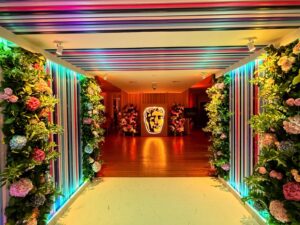
It’s clear Christopher never truly left the theatre, he simply changed his medium and continued to express his creativity. “At stage school we had costume and set design classes,” he recalls. “I’ve taken that and run with it.” Each project feels like a production: a carefully staged environment where flowers, foliage and plants create a temporary world. It exists, then disappears but what remains is an impression. “It’s about how it feels when you walk in,” Christopher says. “The moments we create for our clients and their guests, they’re everything.”